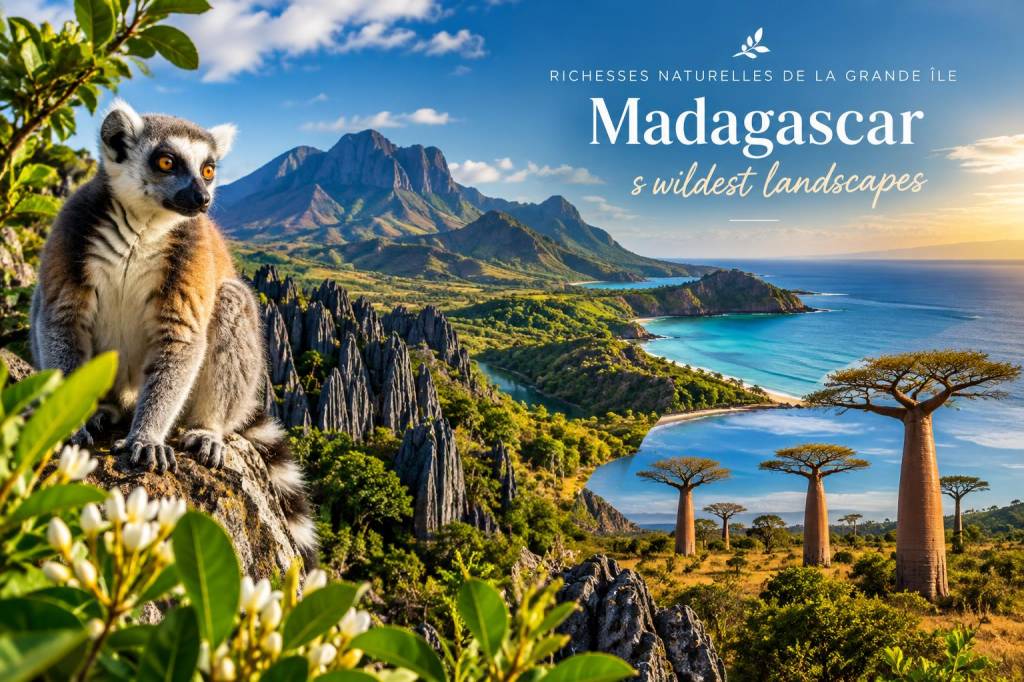
When I think about Madagascar, I do not think first of cities or schedules. I think of space, texture, wind, and silence. I think of richesses naturelles de la Grande Île as a living mosaic: limestone forests, baobab avenues, reef lagoons, dry canyons, rainforests, and stone cathedrals shaped by time. If you want a useful starting point for planning, I recommend reading richesses naturelles de la Grande Île as a companion to this article, because it frames Madagascar as a place where landscapes are not just scenic, but deeply varied and unforgettable.
Madagascar is often described as one of Earth’s great natural laboratories, and that phrase feels accurate to me. Around 90% of its wildlife is endemic, which means it exists nowhere else on the planet. The island is also home to more than 11,000 plant species, with a large share found only here. Those numbers matter, but what stays with me is the feeling of moving from one ecological world to another in a matter of hours. A morning in humid rainforest can become an afternoon among red sandstone formations or baobab silhouettes.
Why Madagascar feels unlike any other island
What makes Madagascar special is not only rarity, but contrast. On one trip, I can stand in a coastal village facing turquoise water, then travel inland to a highland plateau, then continue toward dry western forest or a jagged karst massif. The island’s isolation, geological history, and climate patterns created a patchwork of habitats with extraordinary density.
Several sources help explain this uniqueness clearly. UNESCO recognizes multiple Malagasy sites for both natural and cultural value, including the Rainforests of the Atsinanana. WWF highlights Madagascar as one of the world’s highest-priority biodiversity hotspots. Madagascar National Parks manages a network of protected areas that includes some of the country’s most visited ecosystems. Together, these references tell a consistent story: Madagascar is not simply beautiful, it is globally important.
- Endemism: roughly 90% of wildlife is unique to Madagascar.
- Botanical richness: more than 11,000 plant species are recorded.
- Protected areas: Madagascar National Parks manages a large network of reserves and parks.
- Landscape diversity: rainforest, dry forest, spiny thicket, mangroves, reefs, canyons, and highlands all coexist on one island.
My favorite natural regions to compare
I like to think of Madagascar as a destination you read by region rather than by single attraction. Each zone has its own rhythm, climate, and visual identity. If you plan well, you can compare them in one journey and feel the island’s full range.
| Region | Landscape character | What I remember most | Travel value |
|---|---|---|---|
| Andasibe area | Humid rainforest | Dense green canopy, calls of indri lemurs | Strong for wildlife and short nature walks |
| Avenue of the Baobabs | Dry western plain | Ancient trunks glowing at sunset | Iconic scenery and easy photography |
| Tsingy de Bemaraha | Karst limestone formations | Stone needles and suspended bridges | Excellent for adventure and geology |
| Isalo | Sandstone massif and canyons | Natural pools and eroded cliffs | Ideal for hiking and dramatic views |
| Nosy Be region | Coastal and marine landscapes | Warm water, reefs, palms, relaxed pace | Best for sea time and snorkelling |
Rainforest moments that stay with me
The eastern side of Madagascar is where I most strongly feel the island’s living pulse. Rainforest here is not a decorative backdrop. It is thick, wet, and full of sound. In Andasibe and the broader eastern corridor, I remember mist on leaves, frogs hidden in damp undergrowth, and the sudden call of an indri echoing through the trees. It is a place where every step reveals movement.
For readers who care about wildlife, the eastern forests are among the most rewarding areas in the country. Lemurs, chameleons, frogs, birds, orchids, and moss-covered trunks create a layered natural scene. I also find the experience emotional, because the forest feels fragile. Visiting with a local guide changes everything: I hear more, notice more, and understand more about what is at risk.
Practical note: these forests are often wet, so I pack light rain protection, quick-dry clothing, insect repellent, and sturdy shoes. Morning walks usually feel more active and comfortable than late-afternoon walks, especially after rain.
Dry forests, baobabs, and the western horizon
When I move west, the entire palette changes. Green becomes sparse in places, the light feels harder, and the silhouettes become stronger. This is where the baobab becomes a symbol rather than a tree. I have stood before the Avenue of the Baobabs and felt the kind of silence that makes a traveler stop speaking. The trees seem prehistoric, as if they belong to another scale of time.
The western region also reveals dry forest ecosystems and limestone landscapes. These areas are valuable not only because they are striking, but because they show how adapted life can be under pressure. Some species survive with limited water, intense heat, and seasonal change. From a travel perspective, this is where Madagascar feels most sculptural. Light and shadow matter here. Sunrise and sunset are especially effective if you want the landforms to reveal their shape.
- Best light: early morning and late afternoon.
- Best framing: wide horizons, low-angle views, and silhouettes.
- Best pace: slow driving with time for roadside stops.
Stone landscapes and adventure in Tsingy and Isalo
Some places in Madagascar feel less like scenery and more like architecture built by nature. Tsingy de Bemaraha is one of them. Its limestone pinnacles rise into sharp formations that can seem almost impossible from a distance. Walking there requires attention and a bit of nerve, but the reward is a view unlike anything I have seen elsewhere. Suspended paths, narrow passages, and mineral textures make the experience feel physical and memorable.
Isalo offers a different kind of drama. Instead of sharp stone blades, I find wide sandstone massifs, sculpted canyons, pools, and weathered ridges. Hiking here feels expansive. The land opens up, and the sky seems larger. I like Isalo because it combines effort and relief: a demanding trail can end in a clear pool or a shaded resting place. That contrast is one of the reasons Madagascar keeps drawing me back as a nature destination.
For travelers comparing these two landscapes, I would say this: Tsingy feels like a technical miracle, while Isalo feels like an open-air sculpture park with room to breathe.
Coasts, reefs, and marine life
Madagascar is not only about land. Its coastal environments deserve equal attention. The waters around Nosy Be, Île Sainte-Marie, and several northern and western coastal zones offer coral reefs, whale activity in season, mangroves, and calm lagoons. If I have time, I always try to include at least one marine stop, because it adds a completely different dimension to the island.
Marine diversity matters here as much as terrestrial diversity. Snorkelling reveals reef fish and bright coral structures, while seasonal excursions can bring sightings of humpback whales near Île Sainte-Marie. Mangrove zones are equally important from an ecological perspective, because they protect shorelines, shelter juvenile fish, and support local fishing communities.
For me, a coastal day in Madagascar works best when it is unhurried: a morning on the water, a simple lunch, then a quiet walk near the shore before sunset.
What I consider before I choose an itinerary
Because Madagascar is so large and infrastructure varies by region, I prefer to choose a trip around a few strong landscape types rather than trying to see everything. That approach reduces fatigue and increases quality. It also makes the journey more coherent.
- If you want wildlife first: focus on eastern rainforest and nearby reserves.
- If you want iconic scenery: include baobabs, Tsingy, and one coastal area.
- If you want hiking: choose Isalo or another sandstone or highland zone.
- If you want sea and rest: build time around Nosy Be or Île Sainte-Marie.
- If you want photography: plan for early light, flexible transport, and extra weather buffer.
I also keep seasons in mind. The dry season usually makes travel easier in many regions, while the wet season can bring richer forest color and stronger waterfalls. The right season depends on what matters most to you: easier roads, better wildlife viewing, or fuller landscapes.
Conservation, responsibility, and what travelers can do
The more I learn about Madagascar, the more I feel that responsible travel is not optional. Forest loss, habitat fragmentation, and pressure on marine systems are real challenges. Visiting can support conservation when travelers choose local guides, stay in responsible accommodation, respect park rules, and spend in communities that depend on sustainable tourism.
Here is the approach I try to follow personally:
- Hire local guides whenever possible.
- Stay on marked paths in protected areas.
- Avoid buying wildlife products or anything linked to habitat damage.
- Carry reusable water gear and reduce plastic waste.
- Choose operators who explain conservation clearly and transparently.
When I travel this way, I feel more connected to place. I am not only observing landscapes; I am participating in a fragile system that needs care.
Useful sources I trust when planning
I like to cross-check nature travel plans with reliable references rather than relying on a single blog or brochure. These are the sources I return to most often:
- UNESCO World Heritage Centre — site listings and conservation context.
- WWF Madagascar — biodiversity and habitat information.
- Madagascar National Parks — park access, regulations, and reserve summaries.
- BirdLife International — habitat importance for birds and protected landscapes.
These references help me separate marketing language from real ecological value, which matters when I am deciding where to spend time and money.